Snake Dreams: An Examination of an Archetype
“Snake, you can share my shade spot, but you have to go to the other side of the rock and you must promise not to interrupt me.”
Snake was getting annoyed. He hissed, “How could I bother you Lizard? All you are doing is sleeping.”
Lizard smiled knowingly. “Oh Snake, you are such a silly serpent. I'm not sleeping. I'm dreaming.”
Snake wanted to know what the difference was, so Lizard explained. “Dreaming is going into the future, Snake. I go to where future lives. You see, that is why I know you won't eat me today. I dreamed you and know you are full of mouse.”
— Jamie Sams & David Carson
Snakes or serpents show up quite frequently in dream reports worldwide, yet their appearance is far from universal in terms of significance. Serpents may represent healing to one individual, for a commonly utilized medical symbol is the snake coiled about a staff; this emblem is associated with the Greek god Asclepius, lord of healing and medicine. Paradoxically, snake venom has the potential to either harm or heal — some snake bites are lethal, yet other species' venom holds medicinal value. In many ancient civilizations snakes symbolized the underworld, the realm of the dead; they are associated with death and rebirth due to their ability to shed and rejuvenate their skin.
In an earlier blog, Another Look At Precognition: Can A Dream Save A Life?, I mentioned a precognitive dream which forewarned of my uncle's heart attack and father's death, but I did not actually recount the dream. It is titled Twisted Snakes Bite:
There were 3 snakes slithering together across the lawn — twisted, almost braided — forming 1 body with 3 heads. They were all mostly black, but each had an accent color running through the black: 1 turquoise-blue, 1 red, and 1 yellow — the 3 primary colors; the colors were shimmery.
It bit, at first dad, and then it seemed like uncle L — it was poisonous/venomous — it kept vacillating from dad to uncle L. I was telling someone about the dream. I said “what does the snake represent? Does it have to do with them, or just a type of warning?” As I am telling them about this dream I am saying I thought it could be a warning for someone else's father. “C” is in the dream — something to do with a school… some stuff going on with a university.
I awoke and then went back into the dream discussing the symbolism of snakes with a nondescript dream character. We observed the dream as one would a sports replay, like they do during televised athletic events, reviewing the repeated Twisted Snakes Bite scene on a large flat screen, carrying on in a sort of sports announcers' commentary. Several weeks following this dream my uncle was rushed to the hospital due to a heart attack, where he flat-lined, but was revived; another few weeks passed, and my father, who had had a heart attack ten years prior to my uncle (i.e. bit dad first), died from this second, more powerful heart attack. The significance of “C's” appearance in the dream is striking, for he was close to my father's age, had departed two years earlier within the same month, and died in the same exact way while asleep: seizure, stroke, heart attack.
Devotees of the Hindu goddess Shakti honor her in the form of a snake. She and her serpents are associated with the spiritual and psychic awakening of Kundalini (literally, snake), which arises from a coiled position at the base of the spine up to the pineal gland, opening the third eye or Ajna chakra. This awakening is also depicted in Egyptian artwork, with the brows of deities and pharaohs adorned with the Uraeus, a sort of cobra-crown worn over the third eye to symbolize this awakened state (it also represented sovereignty and royalty); the Uraeus or upright cobra is an emblem of the goddess Wadjet, patroness of the Nile Delta and protector of all Lower Egypt. The aroused serpent fire is also associated with sexual excitation; and while the snake consuming its own tail (in Greek, Ouroboros, “he who eats the tail”) is often interpreted as a symbol for eternity, this icon has also been understood to symbolize sexuality and fertility.
Conversely, other individuals, particularly followers of the Old Testament, may view serpent dreams as representing feelings or situations connected with wickedness, temptation or sin. The early Hebrews associated the serpent in the Garden of Eden with Lilith, Adam's first wife before Eve; however, Christianity identifies the snake with Satan, who seduces Eve into eating the forbidden fruit. In the following “dream within a dream,” Serve the Light, but Watch the Snake, the serpent is an inimical figure who carries the burden of being the proverbial trickster:
I had seen a really long black snake in my room, but then “fell asleep,” and dreamed about “T.” I “wake up” (false awakening) and text message Adam to tell him about the dream I just had about T. He replied that I should tell her about the dream and gives me her number. I call her and we exchange “social niceties” and “haven't talked to you in a while” type talk. I tell her the “dream” that I had about her — that she had two daughters and a son. […]
She tells me how she tries to “find ways to serve the light better” and that her “life is more about giving service.” I think “wow, she's really changed!” For some reason this makes me start talking to her about dream remote viewing and how the US military used remote viewing to find enemy grounds, hostages, etc. Suddenly, I see a black snake again and think, “Double-dealings.” My next thought: “But I don't really feel that way about snakes — I see them as Shakti, Kundalini, wisdom, and transformation” — but my immediate reaction to the snake was not to trust her, and this feeling persisted, so I say, “T, I got to go, there's a huge snake in my room.” […]
In this dream I reason I do not hold negative opinions about snakes, even though I maintain “T” is lying to me due to the reappearance of the black snake as I talk about the military locating enemy territories. I marvel at the unconscious' brilliance in casting “T” in the role of liar (i.e. double-dealing), as she had a history of dishonesty and swindling in our youth, which relates to the negative characteristics of her zodiacal sun-sign, Gemini; ironically, the term “service” is a keyword for Virgo, which is my sun-sign, and shares a planetary rulership with Gemini. The god/planet Mercury (Roman name), ruler of both Gemini and Virgo, is notoriously depicted carrying the caduceus, two snakes entwined around a rod flanked by wings, which represents commerce and travel. He is known as a trickster god with a special talent for persuasion; he is the only deity with the ability to freely travel into and out of Pluto's (Hades in Greek) underworld as a guide or “psychopomp” for deceased souls. Ovid, a Roman poet, wrote that Mercury transports Morpheus' dreams from the valley of Somnus to sleeping humans; and Carl Jung wrote the following about Mercury in his book Man and His Symbols:
Again, in the Olympian period of Greek mythology, Hermes recovered attributes of the bird life to add to his chthonic nature as serpent. His staff acquired wings above the serpents, becoming the caduceus or winged staff of Mercury, and the god himself became the “flying man” with his winged hat and sandals.
Here we see his full power of transcendence, whereby the lower transcendence from underworld snake-consciousness, passing through the medium of earthly reality, finally attains transcendence to superhuman or transpersonal reality in its winged flight.
The image of the caduceus and Mercury is illustrated in the following dream titled Tattoo Outlined by G; D to Add Chakra Wheels:
“G” tattooed my back — the tats I have in waking reality weren't there — he outlined, in red ink, an androgynous figure seated in the lotus position with 2 nadis lines entering the top of the head running down either side of the spine — reminded me of 2 snake heads (curved where entering) at the top with their bodies running down the spine to the tailbone. […]
The “nadis,” or subtle energy channels — those snakelike lines tattooed along the spine — resemble the spiraling serpents round the god's staff and the awakening of Kundalini. The seated “androgynous figure” relates to Mercury, who through his Greek name, Hermes, puts the “herm” in the term hermaphrodite.
To the Australian Aborigines the world was created when “The Rainbow Serpent,” a god known by many names varying from region to region, was aroused from his slumber. For the native peoples, “the Dreamtime was the moment when the world came convulsively into being, thrown up in an explosion of energy by ancestral spirits” (Journeys Through Dreamtime: Oceanian Myth, Time Life Books). In a way, Dreaming Snake, Sleep Talking Girl, from my own dream journal, partakes in this particular Aboriginal mythology:
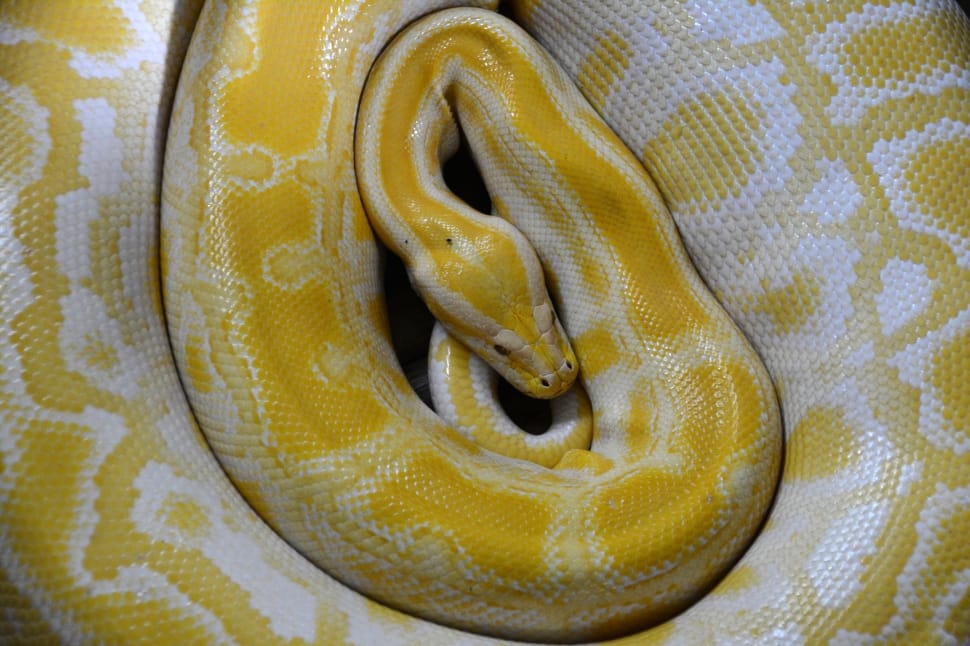
[…] Recall going into a public bathroom with a huge sleeping snake (pale yellow with darker yellow leopard-like spots, head bigger than mine) on a counter elevated to like head height — the snake was part of this bathroom — the bathroom was painted red and seemed to glow.
Adam was in line to get into the bathroom — someone saw us hugging and told his girlfriend — she got all tensed up (like her relationship was being threatened). When she approached and saw it was me she relaxed — I looked up, saw her and we embraced.
Adam went into a vacant stall. He was in there a while. When he came out he looked high — I said, “it's like being on acid and shrooms all at once being in there.” He was starry-eyed saying, “Mind-blowing.” It had something to do with the sleeping snake — like experiencing its dreams when you went into the stalls. […]
The “Dreaming Snake” not only relates to Aboriginal folklore, but yet again carries undertones of the Judeo-Christian Garden of Eden; and my dear friend Adam seems to embody the archetypal first man in the two snake dreams in which he is featured. While the black snake represented deception in the first “Adam dream,” the second dream of the sleeping yellow serpent enabled him to experience its mind-expanding dreams.
Within the four dreams I have cited, one can see a diversity of meanings surrounding a single image. In the first dream the twisted snakes represented artery blockages and served as an omen for two imminent heart attacks; in the second dream the black snake signified double-dealing; the third depicted the union of masculine and feminine polarities; and in the fourth example, the dreaming snake denoted the expansion of consciousness, or the Jungian concept of transcendence. Dream dictionaries fall short for this very reason. They may be used as springboards to discover the associations others have made to a symbol, but these definitions must be weighed against our own personal connections to the image, the manner in which the symbol has expressed itself in the dream, and any feelings which may have been evoked. Apparently, snakes can mean many things to a single person, let alone dreamers from various cultural backgrounds, family conditioning, personal proclivities and experiences. Examining my own dreams, and seeing snake's significance vary within my journal alone, further supports the idea that dream images are not exactly universal in meaning — though we cannot dismiss the fact that we often share similar viewpoints cross-culturally with respect to our symbols.
The next time you are tempted to regard dream dictionaries as authorities on interpreting a symbol, remember the numerous ways this one dreamer used snake's image and ask yourself: how could any particular symbol represent a ‘collective meaning’ when one person can dream up snakes in such diverse ways?